Launching your pouch brand globally but confused by the laws? A single misstep in a new country can cost you a fortune. I'll explain the complex global legal landscape.
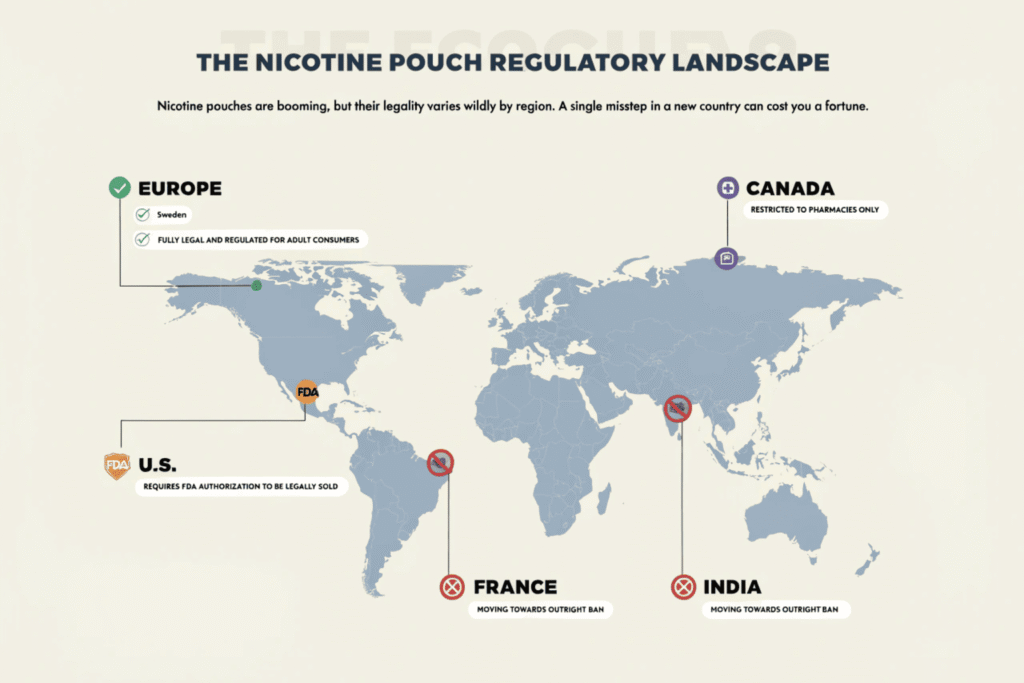
Nicotine pouches are fully legal and regulated for adult consumers in markets like Sweden and the UK1. In the U.S., they require FDA authorization to be legally sold2. Other countries restrict them to pharmacies (Canada)3 or are moving to outright bans (France, India).
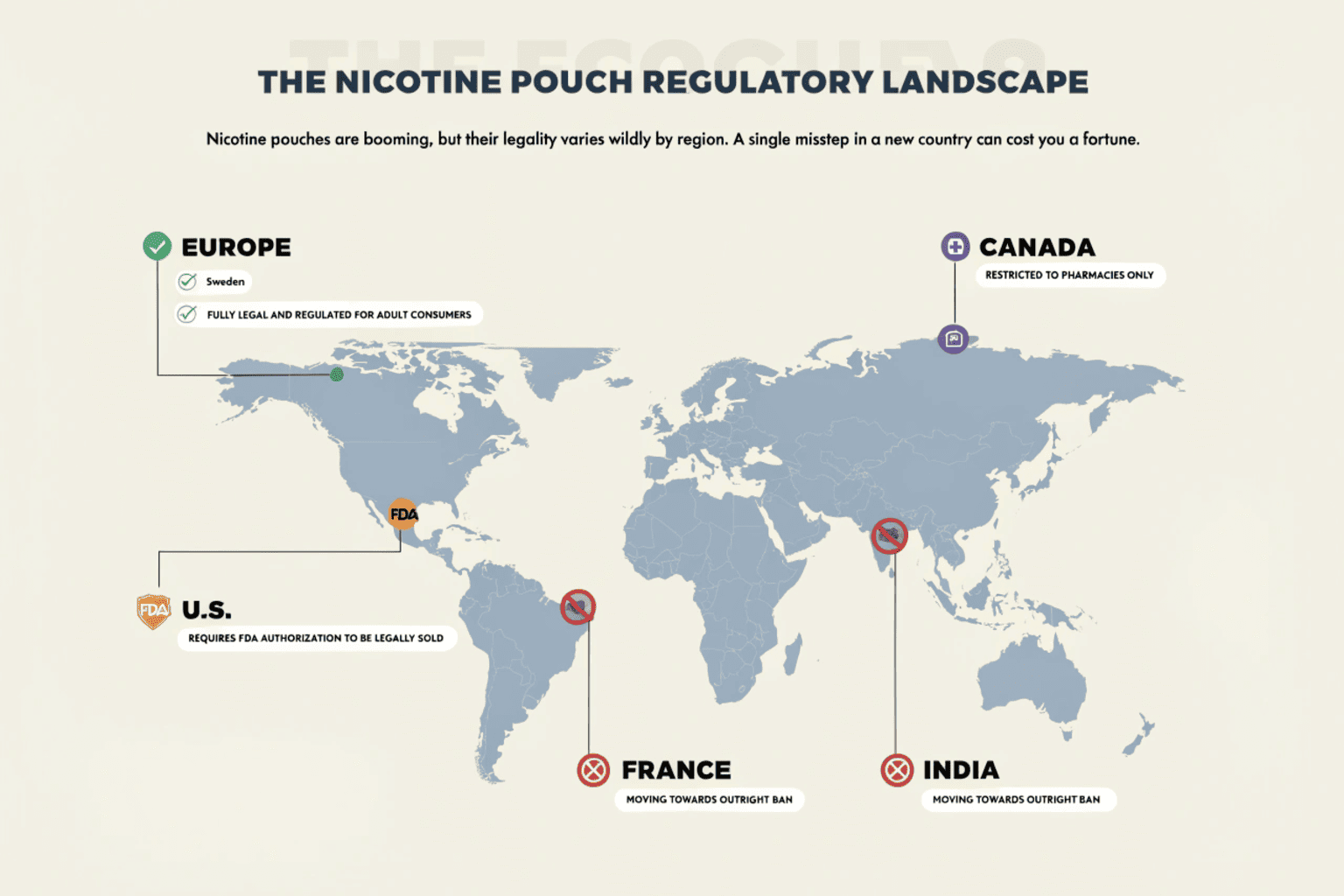
As a manufacturer, the first thing I tell my clients is that "legal" is a complicated word. The rules are changing fast. In a press release issued on May 15, 2026, the WHO noted that approximately 160 countries currently have no specific regulations in place, 16 countries prohibit sales, and 32 countries have some form of regulation4. This shows just how fragmented the world is. A product that's a best-seller in one country could be illegal contraband in another. To succeed, you need to understand the different types of legal- A consumer good? A pharmacy product? Or something else entirely? Let's break it down country by country.
Where are nicotine pouches legal in Europe?
Hoping to tap into the European market? It's a minefield of different rules where one country's success formula is another's illegal product. Don't get caught out.
Nicotine pouches are legal and widely available in countries like Sweden and the UK5, with regulations on age and marketing. However, they face bans or heavy restrictions in France, Belgium, and the Netherlands. There is no single EU-wide rule.
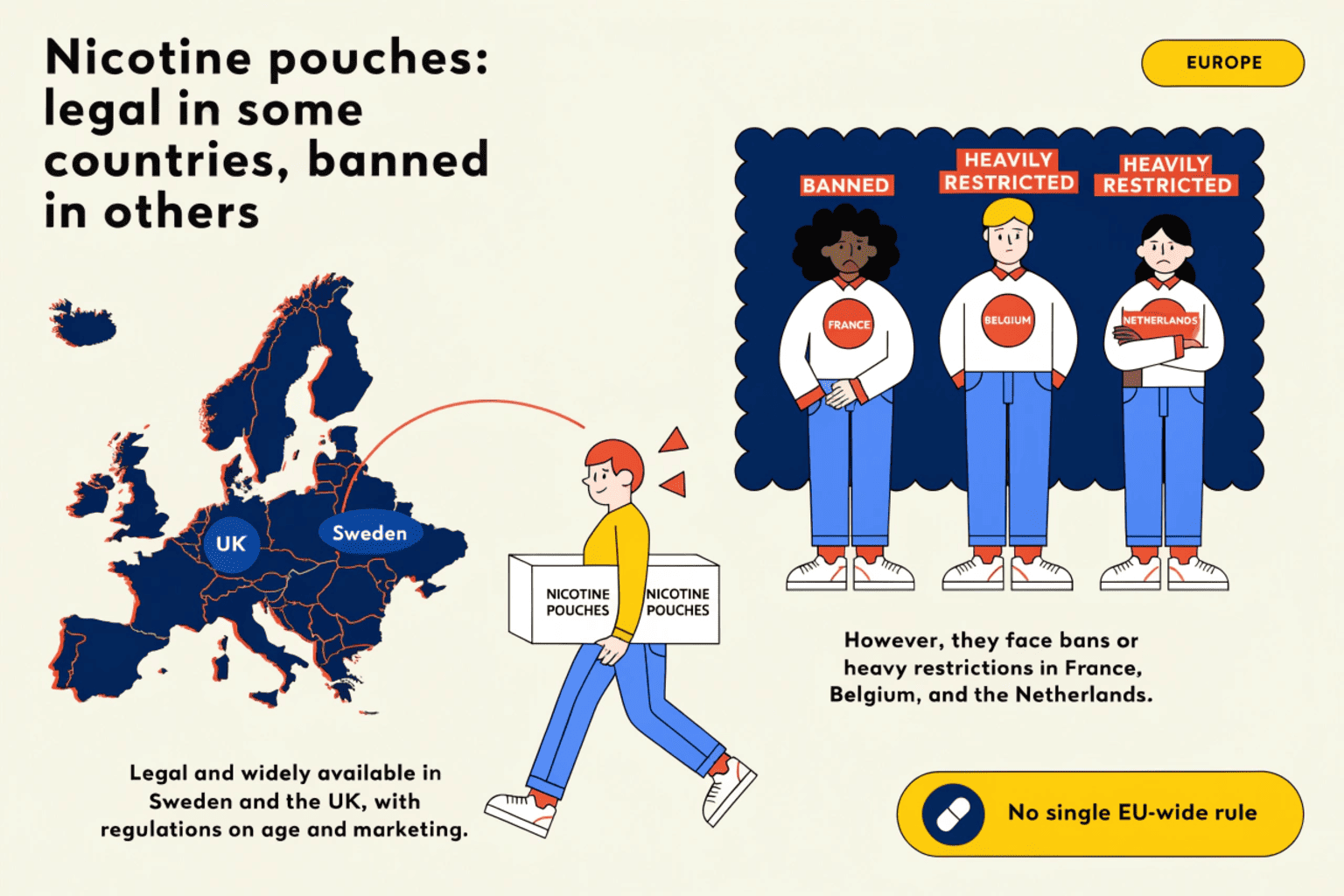
Europe is the most fragmented market I work with. There is no unified EU policy for nicotine pouches, so each country makes its own rules. This creates a confusing patchwork. For example, Sweden, the birthplace of snus, has a mature and well-regulated market for tobacco-free pouches. The UK is similar, treating them as a consumer product with age restrictions. But just across the channel, the story is completely different. Countries like Belgium, the Netherlands, and soon France have banned sales entirely, citing youth protection concerns. This means that as a brand, you can't have a "European strategy"; you need a strategy for each individual country. We design products specifically for each market's unique rules.
European Market Models
| Legal Model | Example Countries | What It Means for Brands |
|---|---|---|
| Regulated Consumer Market | Sweden, UK, Czechia | Legal to sell in general retail with age-gating and marketing rules. |
| Strictly Regulated/Grey Market | Germany, Poland | Legality can be complex, with rules on nicotine content or sales channels. |
| Banned or Moving to Ban | France, Belgium, Netherlands | Sale is prohibited. These are "no-go" markets for pouch sales. |
Are Nicotine Pouches Legal in Germany?
Germany seems like a promising market, but the rules are notoriously unclear6. Brands that enter without understanding the local nuances often face unexpected inventory seizures and legal trouble.
Yes, nicotine pouches are in a legal grey area in Germany. They are not explicitly banned, but their classification is disputed, leading to inconsistent enforcement, potential seizures, and varying rules on nicotine content and where they can be sold.

Germany is one of the trickiest markets in Europe. There isn't a clear federal law for nicotine pouches. Instead, their legal status depends on how they are classified by local authorities. Are they a foodstuff? In that case, the nicotine is an unapproved additive, making them illegal. Are they a tobacco-like product? Then other rules apply. This has led to a situation where some states and cities allow sales, while others conduct raids and seize products. For my clients looking at Germany, I always advise extreme caution. It's a market where you might find success online or in specialty shops, but the risk of legal challenges is high. We focus on ensuring the product meets the strictest possible interpretation of German food and consumer safety laws.
Navigating the German Grey Market
- No Clear Law: The lack of a specific pouch law creates uncertainty.
- Classification Is Key: Classified as either food, cosmetic, or tobacco-like product, each with different rules.
- Inconsistent Enforcement: Rules can vary significantly from one German state to another.
- High Risk: A market for experienced brands with a high tolerance for legal ambiguity.
Are Nicotine Pouches Legal in France?
Seeing France as a potential market? The window is closing fast. The French government is taking a hard line against oral nicotine, and brands unaware of the changes will be shut out.
No. France has banned the sale of nicotine pouches, with the law taking full effect on April 1, 20267. After this date, it will be illegal to sell these products anywhere in the country.
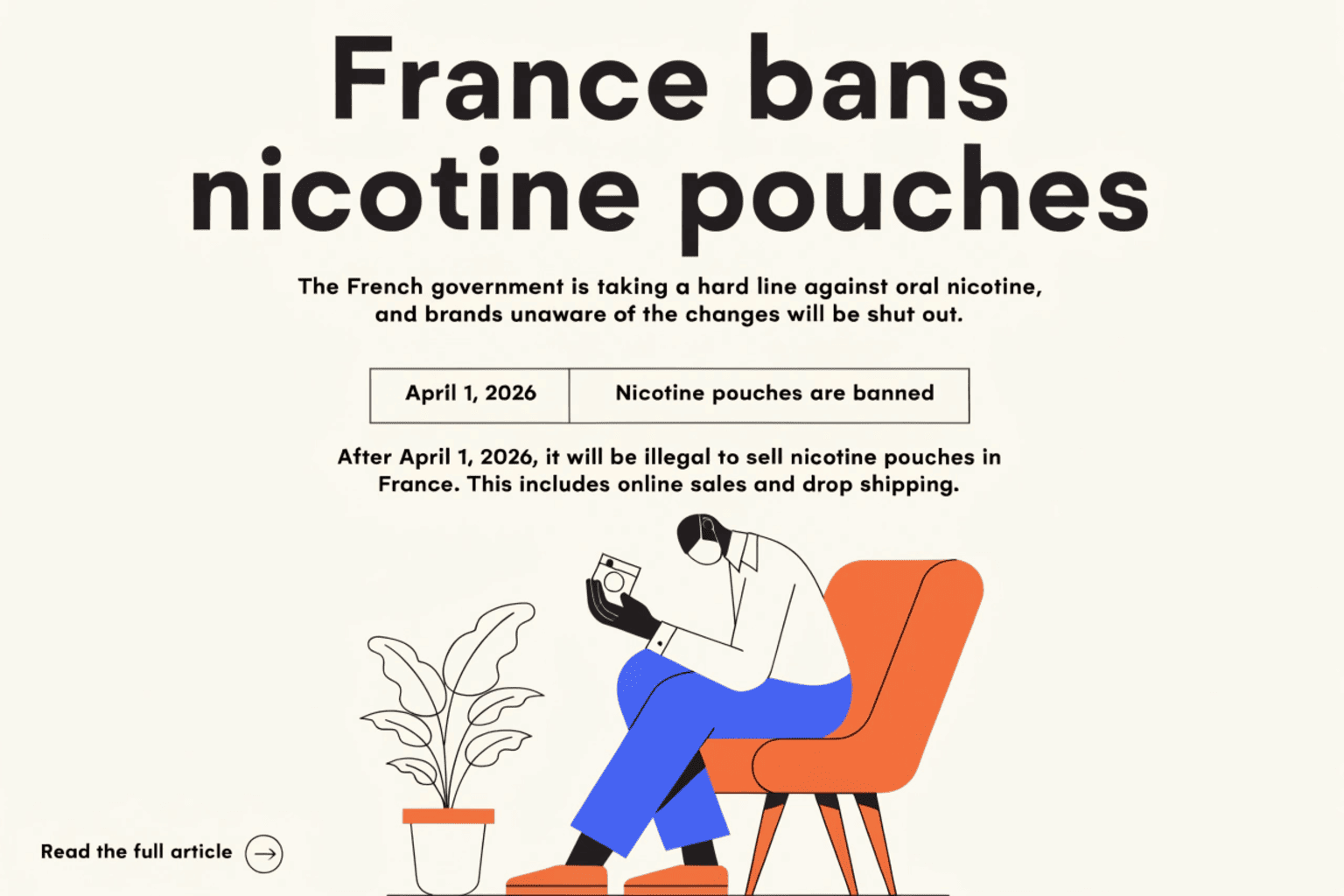
France is a clear example of how quickly a market can change. For a while, pouches existed in a less-regulated space. However, pushed by concerns about their popularity among young people, the government acted decisively. They are treating pouches just like other oral nicotine products and banning them completely. For my business, this means France has moved from a "potential market" to a "closed market." We stopped all development for French compliance and are advising our clients to redirect their efforts elsewhere in Europe. This kind of sudden shift is why our team monitors regulatory news daily. It's crucial for avoiding wasted investment in a market that's about to disappear.
France's Ban: The Details
| Aspect | Regulation |
|---|---|
| Status | Full Ban on Sales. |
| Effective Date | April 1, 2026. |
| Reasoning | To protect youth and curb the rise of new nicotine addictions. |
| Impact | France is no longer a viable market for nicotine pouch brands. |
Are Nicotine Pouches Legal in Australia?
Thinking of selling pouches Down Under? Australia's laws are some of the strictest in the world. Treating it like a consumer market in the US or UK is a recipe for disaster.
No, it is not legal to sell nicotine pouches as a general consumer product in Australia8. Nicotine is classified as a poison, and any product containing it requires a doctor's prescription and can only be supplied by a pharmacy9.
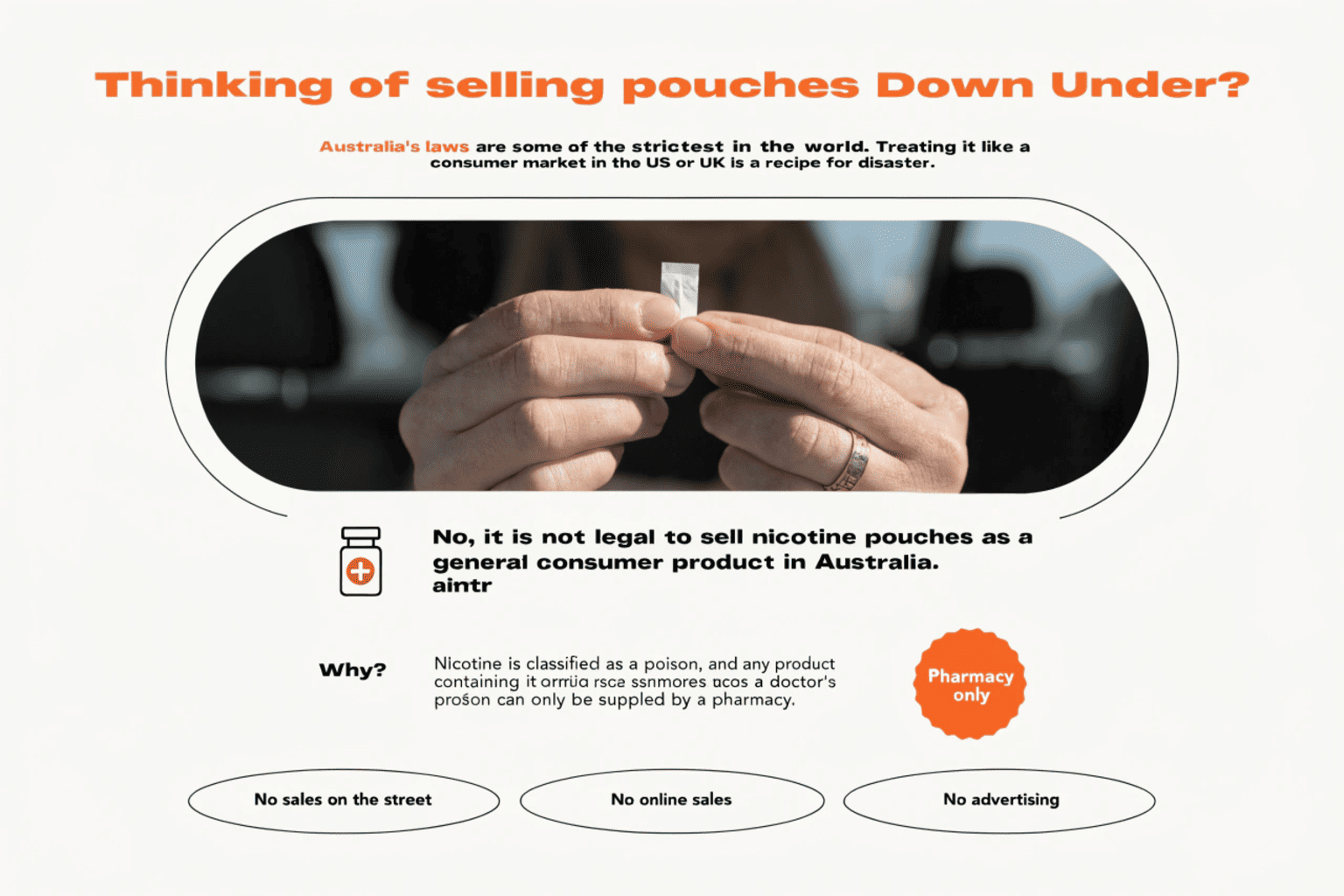
Australia is a perfect example of the "therapeutic model." They don't see nicotine pouches as a lifestyle product or a simple alternative to cigarettes. They see them purely as a medical tool for smoking cessation. To sell them, a product would have to be approved as a therapeutic good, and the customer would need a prescription from a doctor. As of now, no nicotine pouch product has been approved for sale this way. This makes Australia a closed market for consumer brands. I explain to my clients that trying to ship pouches to consumers in Australia is illegal and will result in seizure by customs. The only path is through the medical system, which is a completely different business model.
Australia's Medical-Only Model
- Classification: Nicotine is a Schedule 7 'dangerous poison'.
- Requirement: Doctor's prescription is mandatory for personal use.
- Sales Channel: Only through a registered pharmacy.
- Market Status: Effectively closed to consumer-focused brands. No products are currently registered.
Are Nicotine Pouches Legal in Canada?
Looking at the Canadian market? The rules there are very specific. You can't just put your product on a convenience store shelf like you might in the United States.
Yes, but only under strict regulations. In Canada, nicotine pouches are authorized as a form of Nicotine Replacement Therapy (NRT) for smoking cessation10. They must be sold from behind the pharmacy counter and are limited in flavor.
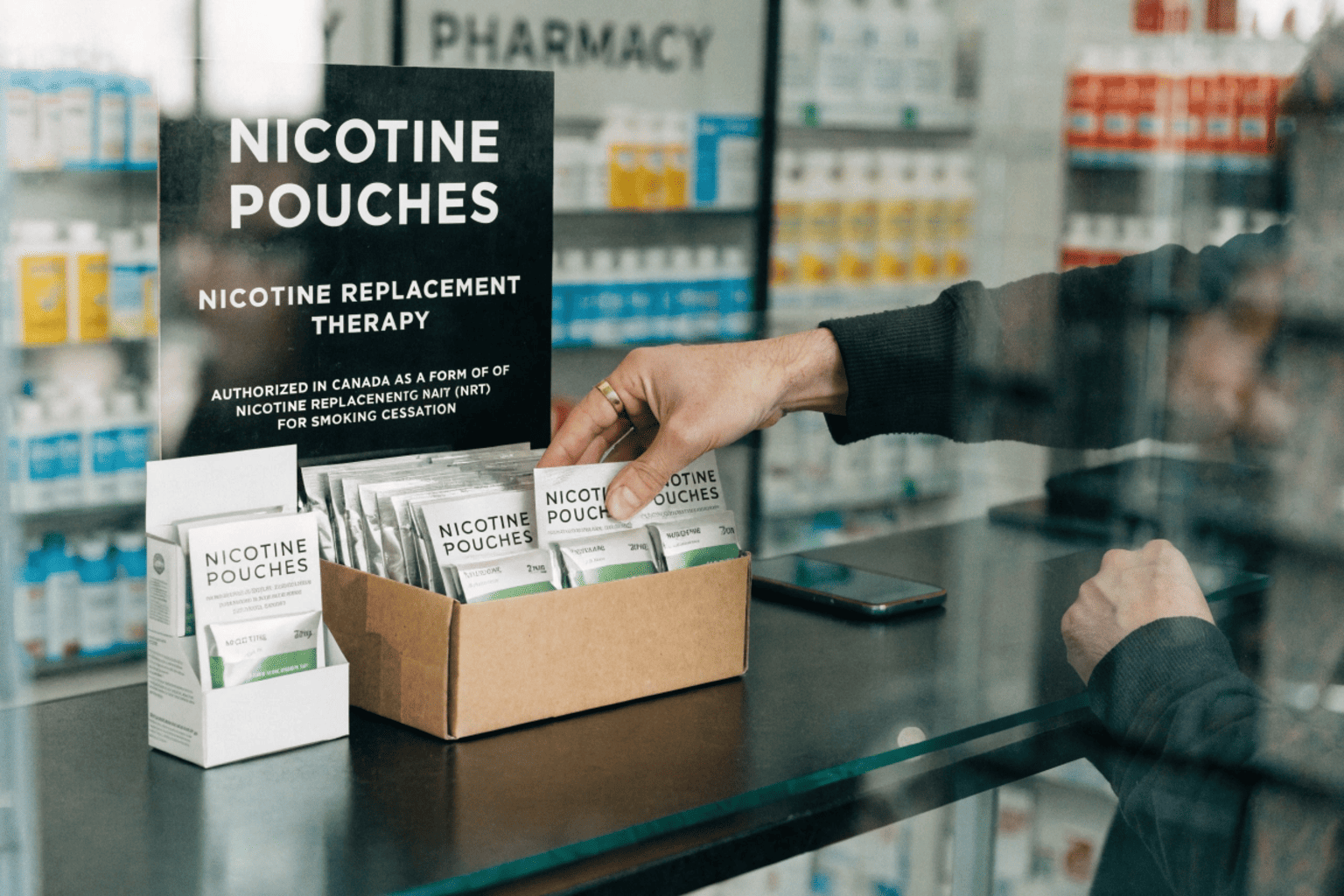
Canada is another country that uses a more medical, controlled approach. Health Canada has authorized nicotine pouches, but not as a consumer product. They are treated as a tool to help people quit smoking. As a result, the rules are tight. I work with clients to create products that meet these specific requirements. This means obtaining the correct licenses, limiting flavors to what the regulators allow (like mint), and designing packaging that clearly states their purpose as a cessation aid. The biggest difference for brands is the sales channel. Being restricted to pharmacies drastically changes the marketing and distribution strategy compared to a mass-market approach.
Canada's Pharmacy-Controlled Model
| Requirement | Details |
|---|---|
| Classification | Authorized as a Nicotine Replacement Therapy (NRT). |
| Sales Channel | Must be sold behind the counter at a pharmacy. |
| Flavor Restrictions | Generally limited to simple flavors like mint. |
| Target Audience | Marketed exclusively to adult smokers looking to quit. |
Are Nicotine Pouches Legal in India?
With its massive population, India looks like an attractive market. But the country has taken a very strong stance against new nicotine products, creating a risky environment for brands.
No, nicotine pouches are banned in India11. The government has included them in its broader ban on electronic cigarettes and other novel nicotine delivery systems to prevent a new wave of nicotine addiction, especially among the youth.
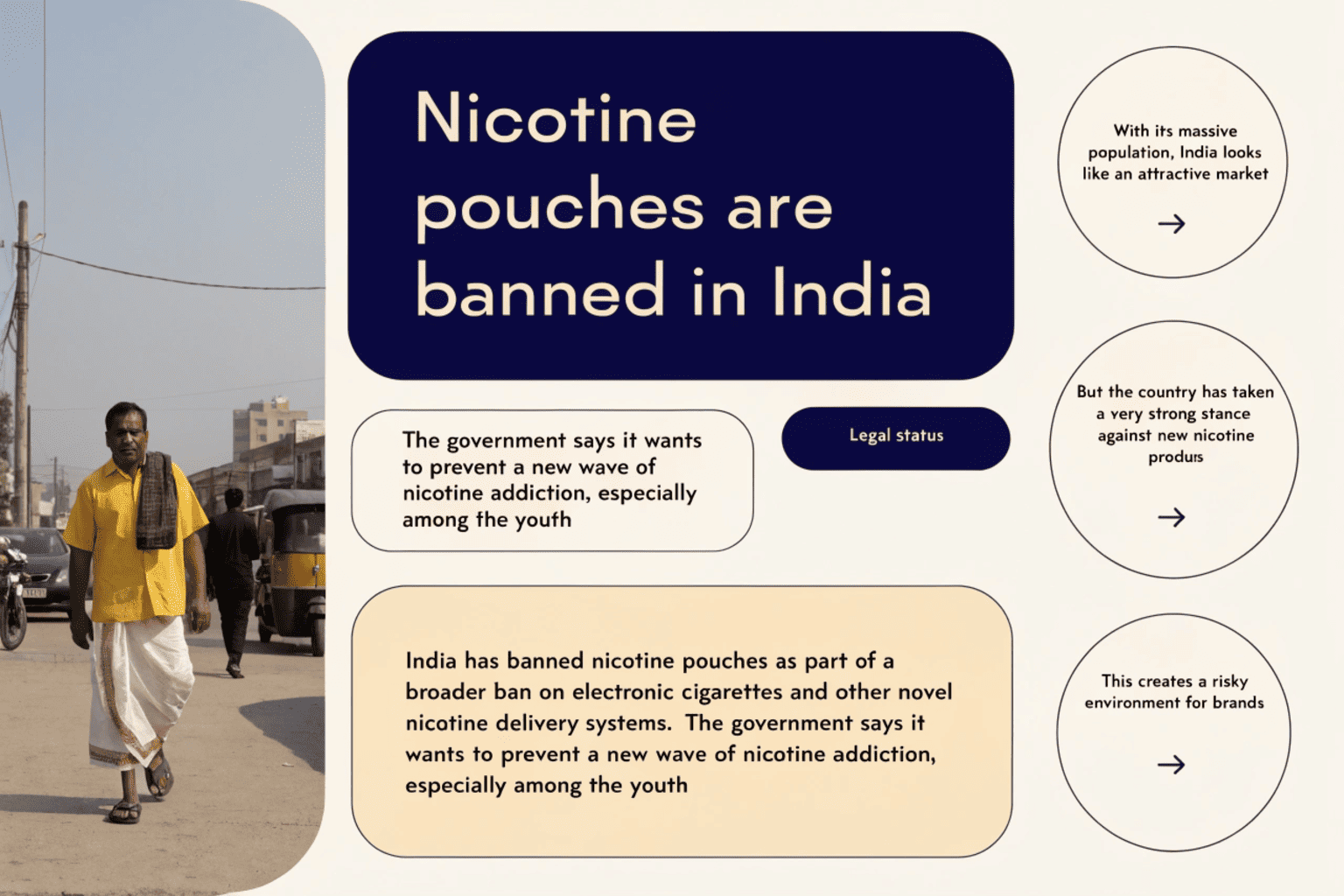
India has a complex history with smokeless tobacco, but when it comes to modern products like pouches and vapes, their position is firm. In 2019, the country passed a comprehensive ban on the production, import, and sale of all electronic nicotine delivery systems (ENDS). While pouches aren't electronic, they have been swept up in this broad public health initiative. The government's goal is to prevent the problems of youth vaping and nicotine use before they can even start. For my clients, my advice is simple: India is a closed market. Any attempt to import or sell pouches there is illegal and carries significant legal and financial risks.
India's Preemptive Ban
- Legal Basis: Included under the Prohibition of Electronic Cigarettes Act, 2019.
- Scope: Covers production, manufacturing, import, export, transport, sale, and advertising.
- Reasoning: A preventative public health measure to protect the population, especially youth.
- Market Status: Completely closed. A "no-go" country.
Are Nicotine Pouches Legal in Thailand?
Planning a trip or business in Thailand? Be extremely careful. The country is famous for its beautiful beaches, but also for its incredibly strict laws on new nicotine products.
No, nicotine pouches are considered illegal in Thailand12. They fall under the same strict ban as vaping products. Possessing, selling, or importing them can lead to severe penalties, including steep fines and even jail time.
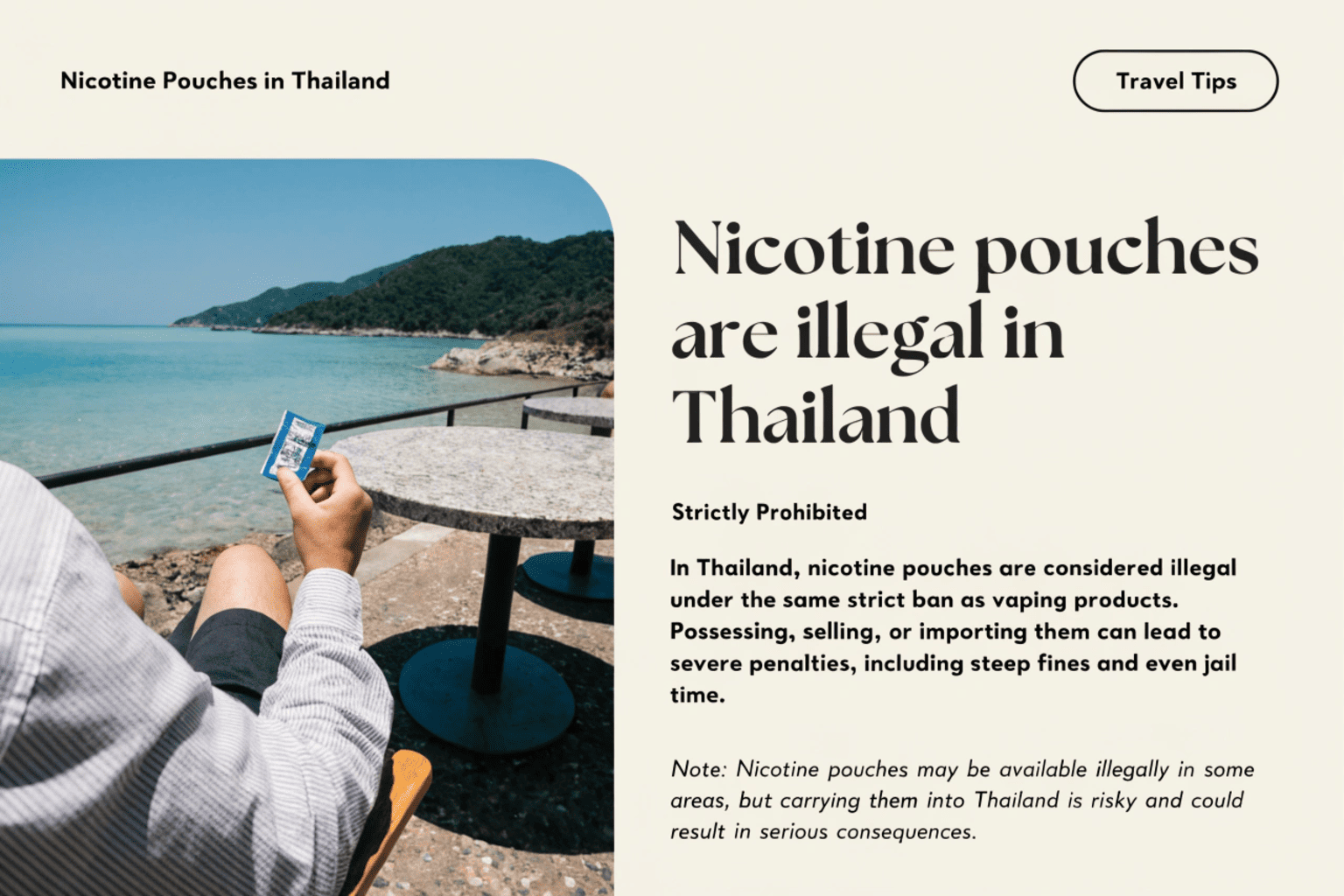
Thailand is one of the worst places in the world to be caught with a banned nicotine product. I've heard stories from travelers who have faced serious consequences for having vapes, and the same rules apply to nicotine pouches. The country has a total ban. The law doesn't distinguish between personal use and selling; possession itself is a crime. The reasoning is to protect public health and stop new forms of nicotine use from becoming popular. My advice is unequivocal: do not bring nicotine pouches into Thailand for any reason. For brands, it's obviously a closed market with zero opportunity and maximum risk.
Thailand's Zero-Tolerance Policy
- Status: Completely illegal.
- Scope: Covers import, sale, and possession for personal use.
- Penalties: Can include very high fines and potential imprisonment.
- Advice: Do not attempt to bring pouches into the country under any circumstances.
Are Nicotine Pouches Legal in Mexico?
Looking at Latin American markets like Mexico? The legal situation there has become much tougher recently, following a presidential decree that caught many businesses by surprise.
No, the sale of nicotine pouches is effectively banned in Mexico. A 2022 presidential decree outlawed the circulation and sale of all electronic cigarettes and novel nicotine products13, which includes tobacco-free nicotine pouches.
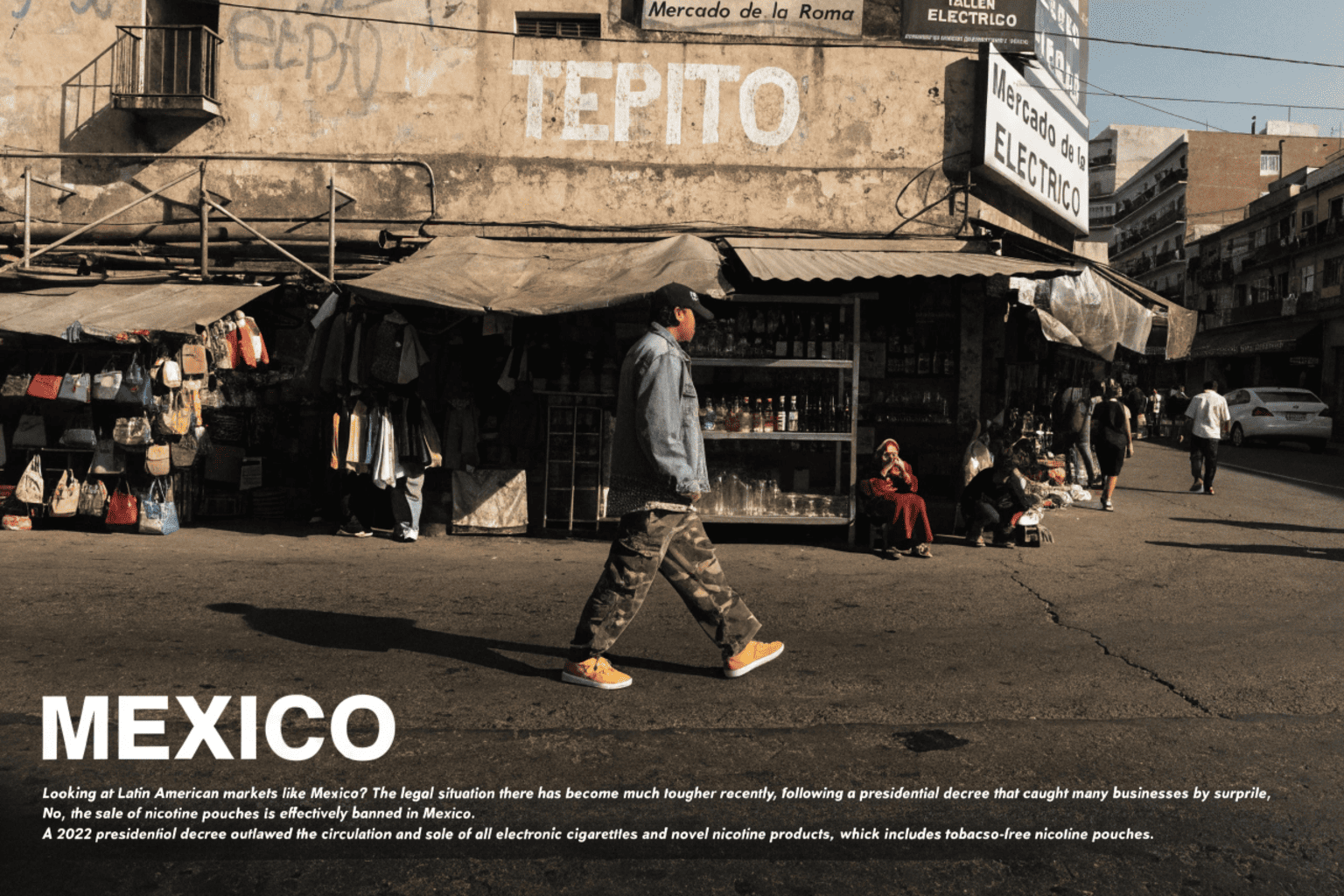
Mexico's market changed overnight14. Similar to India, the government took broad action against all new nicotine products. The president issued a decree that banned not just vapes but any new product that delivers nicotine. This was a major move justified on public health grounds, aimed at protecting people from what the government considers dangerous and addictive products. As a manufacturer, this meant that any plans for the Mexican market had to be scrapped immediately. The country went from a potential grey market to a completely closed one. This is another powerful example of how political will can instantly reshape the legal landscape for our industry.
Mexico's Presidential Decree
- Action: A decree signed by the President in May 2022.
- What's Banned: The circulation and commercialization of all vapes and new nicotine products15.
- Impact: Shut down the legal market for products like nicotine pouches.
- Market Reality: A closed and high-risk environment for brands.
Are Nicotine Pouches Legal in Singapore?
Considering Singapore as a business hub? When it comes to nicotine products, its reputation for being strict and orderly is absolutely true. The rules are clear and the penalties are harsh.
No, nicotine pouches are completely illegal in Singapore16. The country has a total ban on all imitation tobacco products, which includes vapes, heated tobacco, and smokeless products like pouches. Possession is also a crime17.
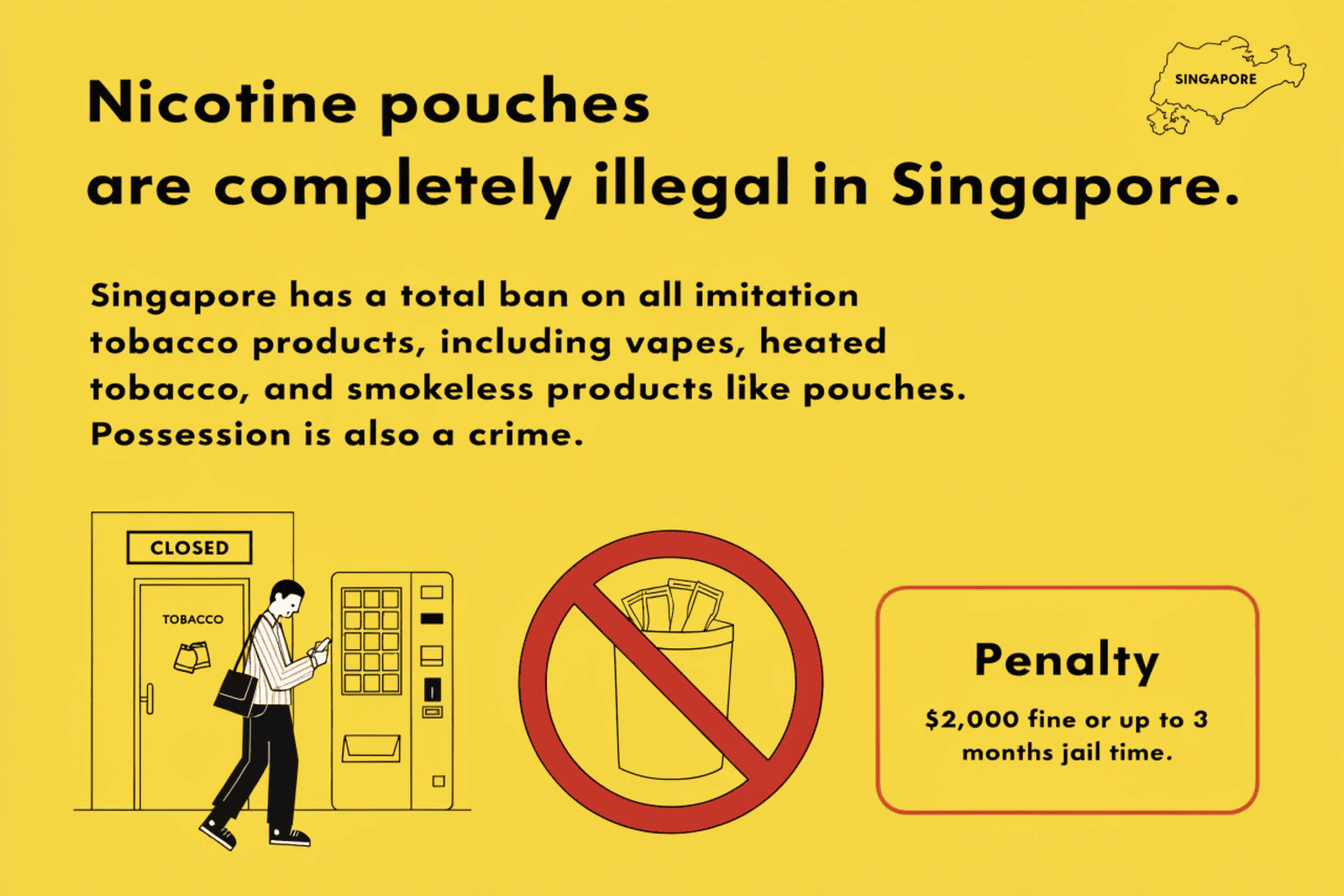
Singapore has one of the most straightforward and restrictive policies in the world. They have a category of "imitation tobacco products," and anything that falls into it is banned. This includes nicotine pouches. The law covers everything from import and sale to simple possession. I always tell people that Singapore is not a place to test the rules. Their enforcement is efficient and the penalties are significant. The country has made a clear choice to prohibit all new forms of nicotine delivery18 to prevent any uptake in nicotine use. From a business standpoint, Singapore is not a market; it's a place to avoid with these products entirely.
Singapore's Total Ban
| Category | Law |
|---|---|
| Product Type | Classified as an "imitation tobacco product." |
| Legal Status | Banned under the Tobacco (Control of Advertisements and Sale) Act. |
| Prohibited Acts | Import, distribution, sale, and possession. |
| Consequence | Fines and other legal penalties for offenders. |
Conclusion
The legality of nicotine pouches is not a simple question. It's a complex, country-by-country puzzle of consumer, medical, and prohibited markets. Success requires deep, localized knowledge and compliance.
-
"Swedish tobacco policy: Key learnings to decrease smoking and ...", https://pmc.ncbi.nlm.nih.gov/articles/PMC11659985/. According to official regulatory summaries from the Swedish Public Health Agency and UK Office for Health Improvement and Disparities, nicotine pouch sales are permitted under consumer regulations for adults, confirming their current legal status. Evidence role: expert_consensus; source type: government. Supports: Nicotine pouches are fully legal and regulated for adult consumers in markets like Sweden and the UK.. Scope note: Regulations may change, and details differ between local jurisdictions. ↩
-
"Nicotine Pouch Products Authorized by the FDA", https://www.fda.gov/tobacco-products/market-and-distribute-tobacco-product/nicotine-pouch-products-authorized-fda. FDA guidance documents on tobacco-free nicotine products outline that non-tobacco nicotine pouches require premarket authorization, supporting this legal requirement. Evidence role: mechanism; source type: government. Supports: In the U.S., nicotine pouches require FDA authorization to be legally sold.. Scope note: The precise authorization process may differ depending on product category and nicotine source. ↩
-
"Only use authorized nicotine pouches as directed, and do not use ...", https://recalls-rappels.canada.ca/en/alert-recall/only-use-authorized-nicotine-pouches-directed-and-do-not-use-unauthorized-nicotine. Health Canada classifies nicotine pouches as Nicotine Replacement Therapies available behind pharmacy counters, confirming the restricted sales model. Evidence role: definition; source type: government. Supports: In Canada, nicotine pouches are restricted to sale through pharmacies.. Scope note: Regulations apply only to approved cessation products; consumer pouches remain unapproved. ↩
-
"WHO warns nicotine pouch brands targeting youth as sales surge", https://www.who.int/news/item/15-05-2026-who-warns-nicotine-pouch-brands-targeting-youth-as-sales-surge. A WHO statement or report summarizing global nicotine pouch regulations would support these numbers, illustrating international regulatory fragmentation. Evidence role: statistic; source type: institution. Supports: WHO reported that approximately 160 countries have no regulation, 16 prohibit sales, and 32 regulate nicotine pouches.. Scope note: Exact figures may vary depending on data year or inclusion criteria for 'regulation.' ↩
-
"[PDF] COT Statement on Oral Nicotine Pouches - Committee on Toxicity", https://cot.food.gov.uk/sites/default/files/2023-04/Publishable%20%20COT%20Oral%20nicotine%20pouches%20-%20final%20v1-0%20Acc%20V_0.pdf. Market and regulatory analyses verified by national health agencies in Sweden and the United Kingdom support the legal retail status for adult consumers. Evidence role: expert_consensus; source type: government. Supports: Nicotine pouches are legal and widely available in Sweden and the UK.. Scope note: Retail availability can vary with local enforcement and product formulations. ↩
-
"[New nicotine products bypass legal regulations and youth ...", https://pubmed.ncbi.nlm.nih.gov/40953592/. German legal summaries from federal authorities or consumer protection agencies confirm there is no explicit federal law governing nicotine pouch classification, supporting the grey-area claim. Evidence role: definition; source type: government. Supports: Germany has no clear legal classification for nicotine pouches, creating regulatory ambiguity.. Scope note: Clarity may change with upcoming regulatory updates or regional interpretations. ↩
-
"Nicotine pouches banned in France - PubMed", https://pubmed.ncbi.nlm.nih.gov/40925658/. An official French government decree or Ministry of Health announcement stating the prohibition date would substantiate the full ban timeline. Evidence role: historical_context; source type: government. Supports: France banned nicotine pouch sales as of April 1, 2026.. Scope note: Effective dates may vary depending on enforcement provisions. ↩
-
"Do Australians use the prescription pathway when using nicotine ...", https://pmc.ncbi.nlm.nih.gov/articles/PMC11337190/. Australian Therapeutic Goods Administration and Department of Health publications classify nicotine as a Schedule 7 poison requiring prescription, confirming these restrictions. Evidence role: definition; source type: government. Supports: Nicotine pouches cannot be sold as a consumer product in Australia due to poison-level classification.. Scope note: Classification applies specifically to active nicotine content and approved therapeutic contexts. ↩
-
"Do Australians use the prescription pathway when using nicotine ...", https://pmc.ncbi.nlm.nih.gov/articles/PMC11337190/. Australian Poisons Standard entries for 'nicotine' list Schedule 4 and Schedule 7 classifications, confirming prescription and restricted supply requirements. Evidence role: mechanism; source type: government. Supports: Nicotine classification as poison in Australia requires prescription and pharmacy supply.. Scope note: Rules apply to nicotine concentration and product type; some non-nicotine alternatives differ. ↩
-
"Only use authorized nicotine pouches as directed, and do not use ...", https://recalls-rappels.canada.ca/en/alert-recall/only-use-authorized-nicotine-pouches-directed-and-do-not-use-unauthorized-nicotine. Health Canada's medical device and drug authorization registry lists approved NRT pouch products, supporting the claim of regulated therapeutic use. Evidence role: mechanism; source type: government. Supports: Canada authorizes nicotine pouches as smoking cessation therapy sold under pharmacy restrictions.. Scope note: Only specific brands authorized qualify as NRT; general consumer pouches remain unapproved. ↩
-
"Lessons Learned From E-Cigarettes Should Affect FDA Regulation ...", https://pmc.ncbi.nlm.nih.gov/articles/PMC12478461/. The Indian Ministry of Health's 2019 Prohibition of Electronic Cigarettes Act and subsequent circulars banning novel nicotine delivery systems support inclusion of nicotine pouches in the ban. Evidence role: historical_context; source type: government. Supports: Nicotine pouch sale and import are banned in India under the Prohibition of Electronic Cigarettes Act, 2019.. Scope note: The Act may indirectly include pouches; confirm with updated interpretations. ↩
-
"Myanmar Enforces Nationwide Ban on E-Cigarettes - Thailand", https://thailand.prd.go.th/en/content/category/detail/id/2874/iid/479981. Thai Excise Department or Customs announcements detail bans on nicotine and vaping products, indirectly confirming inclusion of nicotine pouches under import prohibition laws. Evidence role: definition; source type: government. Supports: Nicotine pouches are illegal in Thailand under bans on novel nicotine products.. Scope note: Specific legal wording may not mention 'pouches' explicitly, but enforcement includes similar products. ↩
-
"The potential impact of removing a ban on electronic nicotine ... - PMC", https://pmc.ncbi.nlm.nih.gov/articles/PMC11092684/. A government record or official legal notice can confirm that in May 2022, the Mexican president signed a decree prohibiting the import and sale of electronic cigarettes and related nicotine delivery products. Evidence role: historical_context; source type: government. Supports: Mexico issued a 2022 presidential decree banning all electronic cigarettes and novel nicotine products.. Scope note: Available sources may summarize the decree’s scope without detailing its enforcement practices. ↩
-
"The potential impact of removing a ban on electronic nicotine ... - PMC", https://pmc.ncbi.nlm.nih.gov/articles/PMC11092684/. Market reports or news coverage can illustrate the immediate economic and commercial effects of Mexico’s 2022 ban on the vape and nicotine sector. Evidence role: case_reference; source type: research. Supports: Mexico’s nicotine product market experienced rapid disruption following the 2022 decree.. Scope note: These sources may provide anecdotal data or estimates instead of quantitative sales data. ↩
-
"DOF: 16/12/2022", https://extranet.who.int/fctcapps/sites/default/files/2024-02/410_DOF%20Decreto%20por%20el%20que%20se%20modifica%20el%20Reglamento%20de%20la%20Ley%20General%20para%20el%20Control%20del%20Tabaco.pdf. An official Mexican health authority or legal publication can confirm the categories included in the decree and clarify that both circulation and commercialization are covered. Evidence role: definition; source type: government. Supports: The decree prohibits the trade and distribution of vapes and new nicotine delivery products in Mexico.. Scope note: Legal language may group products broadly without mentioning nicotine pouches explicitly. ↩
-
"[PDF] SMOKING (CONTROL OF ADVERTISEMENTS AND SALE OF ...", https://extranet.who.int/fctcapps/sites/default/files/2023-04/singapore_annex4.pdf. Singapore’s Health Sciences Authority or legal code under the Tobacco (Control of Advertisements and Sale) Act can document the prohibition of nicotine pouches as imitation tobacco products. Evidence role: definition; source type: government. Supports: Singapore’s law bans nicotine pouches under the classification of imitation tobacco products.. Scope note: Regulatory documentation may not use the term 'nicotine pouch' explicitly but apply broader categories. ↩
-
"Misuse of Drugs Act (Singapore) - Wikipedia", https://en.wikipedia.org/wiki/Misuse_of_Drugs_Act_(Singapore). Singaporean enforcement guidelines or government publications can confirm that possession of imitation tobacco products is punishable under the relevant Tobacco Control Act. Evidence role: mechanism; source type: government. Supports: Singapore criminalizes possession of imitation tobacco products under its tobacco control law.. Scope note: Penalty details vary depending on enforcement context and may apply to specific forms of possession. ↩
-
"Policy lessons from a vaping ban, Singapore - PMC - NIH", https://pmc.ncbi.nlm.nih.gov/articles/PMC12477511/. Policy documents or statements from Singapore’s Ministry of Health can contextualize the rationale for banning new nicotine delivery systems as part of long-term tobacco control strategy. Evidence role: expert_consensus; source type: government. Supports: Singapore’s public health policy emphasizes preventing the introduction of new nicotine delivery systems.. Scope note: Such sources discuss policy objectives rather than confirm intent for every specific product type. ↩